

Surprising claim up front: a single additional confirmation dialog — if it is powered by a correct transaction simulation — can prevent a class of losses that simple address checks cannot. For U.S.-based DeFi traders and protocols, that isn’t trivia; it’s a practical control that shifts risk from opaque contract behavior to readable, quantifiable outcomes. Rabby Wallet, a non-custodial multi-chain wallet built by DeBank, puts transaction simulation at the center of its UX. This article walks through how that mechanism works, why it matters for advanced users, where it breaks, and how to think about trade-offs when choosing a wallet for high-volume, composable DeFi interactions.
Start with the mechanism: transaction simulation means executing a dry-run of the intended call off-chain (or in a sandboxed environment) to estimate exact balance changes, token flows, and gas consumption before a signature is produced. That sounds simple, but the engineering and UX design choices behind a simulation determine whether it is a meaningful safety check or just a cosmetic reassurance. We’ll unpack those choices and translate them into decision-useful heuristics you can reuse across wallets and strategies.
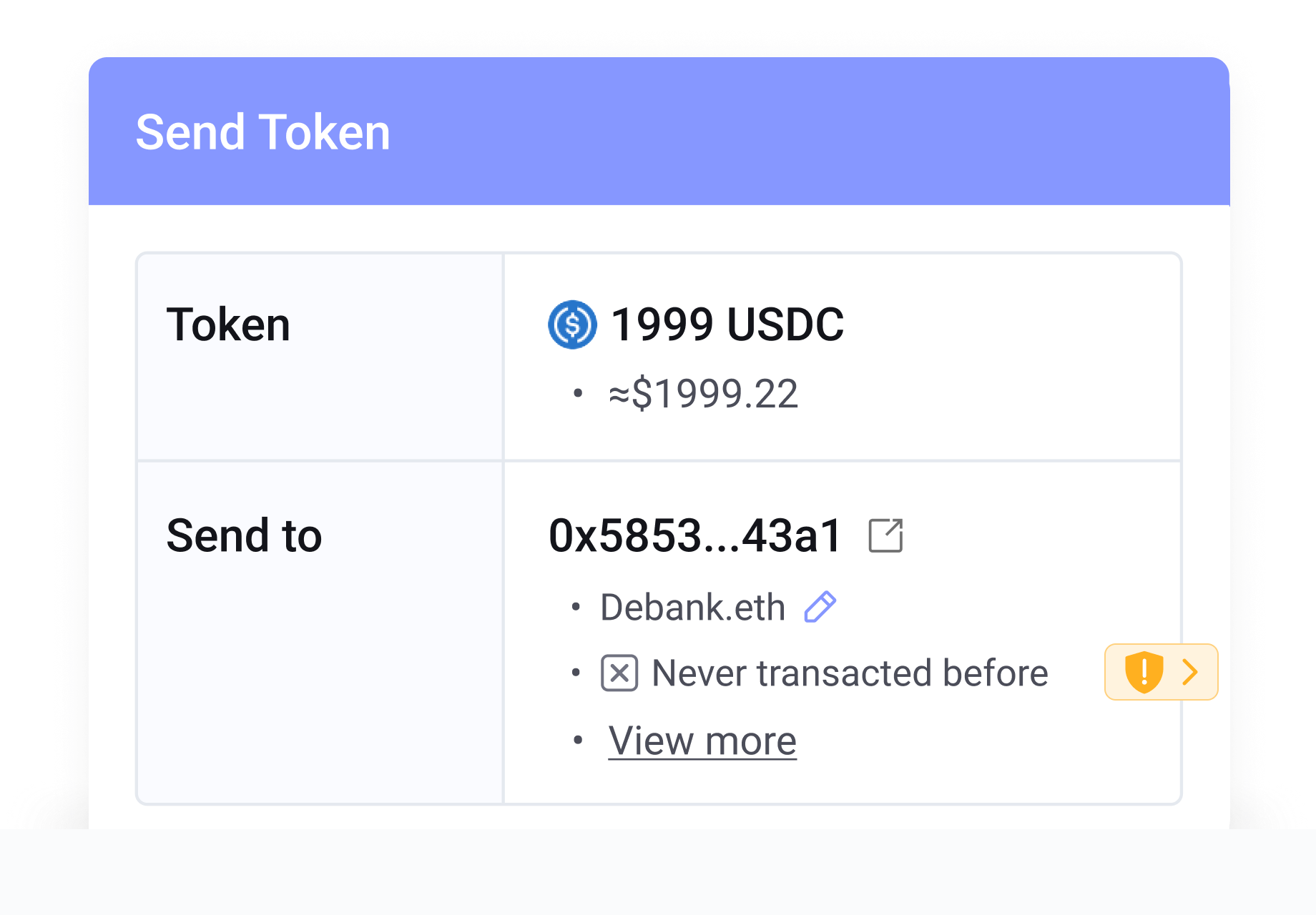
How Rabby’s simulation works and why it reduces ‘blind signing’
At a high level, Rabby intercepts the transaction request from a dApp, builds the raw transaction data, then runs a simulated execution to compute outputs a user cares about: token deltas, approval changes, and gas cost. The wallet surfaces those results in a human-readable form before asking for the private key signature. This turns a cryptic hex payload into three decision variables: would tokens move as expected, what will the fee be, and does the recipient or contract look suspicious?
For DeFi power users who chain together swaps, approvals, and multi-step strategies, this matters because many attacks exploit expectations about intermediate states — for example, a contract that siphons tokens during an approval flow or a swap that routes to a malicious pair. A correct simulation reveals those outcomes in advance. Rabby pairs simulation with a pre-transaction risk scanner that flags known compromised contracts, suspicious approval requests, and non-existent recipient addresses, creating a layered defense.
Beyond simulation: the ecosystem features that matter for active traders
Simulation is necessary but not sufficient. Rabby’s design bundles simulation with several practical features geared for multi-chain DeFi activity: automatic network switching (so you don’t accidentally sign on the wrong chain), a native approval revocation tool (to undo open token approvals quickly), hardware wallet compatibility (Ledger, Trezor, Keystone, CoolWallet and others), and a cross-chain gas top-up facility to move gas tokens into networks where you need to execute transactions. Together these reduce friction and real operational risk for frequent traders and strategists.
There are trade-offs to note. Rabby is a browser extension for Chromium-based browsers and offers mobile and desktop clients, which affects threat models: browser extensions expand attack surface compared with a cold machine, even if the extension is well-audited. It’s open-source under MIT, which increases transparency and external auditability, but open source is not a guarantee of safety — it helps only to the degree reviewers actively audit and the team acts on findings.
Where the simulation approach can break
Simulation fidelity depends on the model: assumptions about gas, mempool state, on-chain oracle values, and atomicity of multi-contract sequences. If a simulator uses stale data or fails to replicate the exact environment (for example, failing to simulate a flashloan or reentrancy edge case), its estimate can be wrong. That’s not a theoretical point: accurate simulation of arbitrage-like, stateful interactions is inherently harder than simulating a simple transfer. Users should therefore treat simulations as powerful signals rather than absolute guarantees.
Another practical limitation is that Rabby currently lacks a built-in fiat on-ramp and native staking inside the wallet—features some rivals offer—so the wallet excels as a transactional and operational security layer rather than a one-stop consumer on-ramp. Also remember the wallet’s history: in 2022 a contract linked to Rabby Swap was exploited for roughly $190,000; the team froze the contract and compensated users, then enhanced audits. That incident underlines that wallet-level protections reduce, but do not eliminate, smart-contract risk that emerges from third-party code.
How to use this understanding to make better choices
If you manage DeFi strategies or run an institutionally sensitive account, prioritize these heuristics when evaluating wallets and workflows:
– Treat simulation as an output you verify: compare the simulated token deltas to your intended amounts and to the dApp UI’s expected flows. If they diverge, pause. Simulations that obscure intermediate approvals or 0x-style wrapper contracts deserve extra scrutiny.
– Use hardware wallets for signing whenever possible and pair them with a wallet that supports hardware devices; Rabby’s broad hardware compatibility is a practical advantage here. Keep the signing device offline except when authorizing.
– Keep approval surfaces minimal: use Rabby’s revocation tool to remove large, persistent allowances and prefer permit-based flows or exact-amount approvals when the protocol supports them.
– For cross-chain activity, take advantage of gas top-up features to avoid signing emergency transactions under pressure; running out of gas is a vector for rushed mistakes.
Decision framework: when Rabby is likely the right pick
Rabby aligns clearly with these user profiles: active traders who interact with many EVM networks, multisig and institutional actors who need integration with Gnosis Safe and enterprise custody, and power users who value a pre-signing explanation of outcomes. If you need an integrated fiat on-ramp or in-wallet staking, Rabby is less of a one-stop shop today; you will layer additional services.
Compare that to alternatives like MetaMask or Coinbase Wallet: MetaMask is ubiquitous and broadly supported by dApps; Coinbase Wallet links to an exchange for on-ramps. Rabby’s differentiator is not novelty but depth of transaction-aware security — simulation plus revocation plus automated network switching — a set tuned to reduce blind-signing risk rather than simplify first-time buying.
What to watch next
Three signals matter for the short-to-medium term: wider adoption of standardized transaction-preview APIs across dApps (which would increase simulation accuracy), further integration between wallets and off-chain risk databases (improving the signal-to-noise of pre-transaction warnings), and how wallets reconcile convenience features (in-wallet swaps, fiat rails) with their exposure surface. If Rabby or others add native fiat or staking, the question will be whether those features are implemented in a way that preserves the simulation-first security posture.
FAQ
Does Rabby’s simulation prevent all smart-contract exploits?
No. Simulation reduces the chance of blind-signing and can reveal many malicious flows, but it cannot prevent logic bugs in smart contracts, oracle manipulation, or races in the mempool. Treat simulation as an important layer, not a silver bullet; continue to use hardware signing, limited approvals, and careful counterparty selection.
How accurate are the estimated fees shown before signing?
Estimated fees are calculated from the simulation using current gas pricing data; they are useful guides but can change with network congestion. For complex, multi-step transactions, actual gas may differ if the transaction’s execution path diverges at run time. If fee sensitivity matters, consider using a gas ceiling and rerunning the simulation just before signing.
Can I use Rabby with a Ledger or Trezor device?
Yes. Rabby supports multiple hardware wallets for signing. For active traders this is a recommended configuration: the extension handles simulation and user interaction while the private keys remain on the hardware device.
Where can I download the extension and try the simulation feature?
You can learn more and access downloads from the official installation page for the rabby wallet extension, and test the simulation in a low-stakes environment before moving significant funds.
Final takeaway: for DeFi power users operating across chains, the move from blind signing to transaction simulation is a genuine risk-reduction advance. But it is a human+machine defense: the wallet provides readable signals, and you must interpret them, limit privileges, and pair them with hardware signing and process controls. Watch for improvements in simulator fidelity and broader dApp support — those are the conditions under which the simulation-first approach will shift from “best practice” to standard practice.